
Around your thirtieth birthday, your skin quietly renegotiates its terms of service. Products that used to work without incident might suddenly cause tightness across your cheeks, or an unexpected redness after a quick morning wash. This is rarely a sign that your face has turned against you. Instead, it usually means the outer layer of skin, known as the stratum corneum, is drying out faster than your sebaceous glands can replenish it.
The skin barrier acts like a brick wall where dead skin cells are the bricks and lipid mixtures serve as the mortar. When external stressors or shifting internal biology deplete those lipids, microscopic gaps form between the cells. Moisture escapes into the dry air, while potential irritants slip inside. Repairing that barrier after thirty requires moving away from aggressive resurfacing and shifting toward bio-identical lipid replenishment, targeted humectants, and a bit of patience.
How moisture retention changes as natural sebum production decreases
Human skin reaches peak sebum secretion in late adolescence and the early twenties. Sebaceous gland activity is largely driven by androgens, and as circulating hormone levels level out and steadily decline through your thirties, sebum production slows down. For women, this shift can translate to an estimated drop of roughly 8 percent in surface lipids per decade, a decline that often accelerates around perimenopause. Men experience a similar downward trend, though their thicker dermis delays the noticeable impact by a few extra years.
Sebum contains squalene, wax esters, triglycerides, and free fatty acids. It forms a hydrophobic film on the skin surface that blunts the rate of transepidermal water loss, often abbreviated as TEWL. When this natural coating thins, water moves more rapidly from the deeper dermis into the stratum corneum and evaporates into the surrounding air. If you live in an environment with low relative humidity, or work in an office with aggressive winter heating, this water loss accelerates rapidly.
Along with lower sebum production, the skin produces fewer natural moisturizing factors, or NMFs. These water-soluble compounds, which include amino acids, lactic acid, pyrrolidone carboxylic acid (PCA), and urea, sit inside the corneocyte cells and absorb ambient water. When your internal production of both NMFs and surface sebum dips at the same time, your skin can feel taut and uncomfortable within twenty minutes of drying off after a warm shower.
If you experience sudden, severe peeling, swelling, or crusting, these symptoms fall outside typical barrier fatigue. A board-certified dermatologist should evaluate persistent or painful flare-ups to rule out contact dermatitis, rosacea, or underlying conditions like eczema before you experiment with new products.
The three fundamental lipids required for barrier repair
Repairing a damaged barrier is not simply a matter of slathering on heavy kitchen oils. The intercellular matrix of the stratum corneum relies on a strict composition of three primary lipid classes: ceramides, cholesterol, and free fatty acids. Decades of dermatological research show that these lipids organize into lamellar sheets, creating an impermeable seal against fluid loss.
When one of these lipid classes drops out of balance, the protective matrix destabilizes. Many over-the-counter moisturizers advertise ceramides on their labels, but if the formula lacks the matching ratios of cholesterol and fatty acids, the barrier may take significantly longer to mend. Scientific formulations frequently aim for an equimolar ratio, often cited around 3:1:1 or 1:1:1 of ceramides, cholesterol, and fatty acids, to mirror the skin's natural architectural blueprint.
| Lipid Class | Primary Function in Barrier | Ideal Cosmetic Ingredients |
|---|---|---|
| Ceramides | Maintain lamellar sheet cohesion and prevent moisture evaporation | Ceramide NP, Ceramide AP, Ceramide EOP, Phytosphingosine |
| Cholesterol | Stabilizes lipid fluidity and aids membrane recovery | Pure Cholesterol, Phytosterols, Wool-derived lanolin fractions |
| Free Fatty Acids | Provide acidification, lipid flexibility, and antimicrobial protection | Linoleic acid, Stearic acid, Palmitic acid, Evening primrose oil |
Ceramides are complex sphingolipids that make up nearly half the lipid mass in a healthy stratum corneum. Look for products that list Ceramide NP, Ceramide AP, or Ceramide EOP alongside phytosphingosine, a precursor that helps the skin synthesize its own ceramide species. Phytosphingosine also carries mild natural antimicrobial properties that keep opportunistic bacteria in check while your skin is compromised.
Cholesterol constitutes roughly 25 percent of the barrier matrix. While it often receives a bad reputation in cardiovascular discussions, on your skin it is indispensable. Topical cholesterol provides structural rigidity, preventing the lipid matrix from becoming too fluid or breaking down under temperature shifts. Without adequate cholesterol, applied ceramides cannot form the tight crystalline structures needed to halt moisture loss.
Free fatty acids fill out the remaining volume. Straight-chain saturated fatty acids like stearic acid offer rich physical occlusion, while polyunsaturated fatty acids like linoleic acid help modulate local inflammation. Linoleic acid is particularly important for individuals who experience both barrier dehydration and adult breakouts, as sebum low in linoleic acid tends to become thick, sticky, and pore-clogging.
Common mistakes that compromise the moisture barrier
Most barrier damage after thirty is unintentional and self-inflicted. A routine that worked well during your oily twenties can quietly turn abrasive as your natural replenishment rates drop. Correcting these habits often yields visible improvements within two to three weeks.
- Overusing foaming surfactants: Cleansers with strong anionic surfactants, such as sodium lauryl sulfate, strip away structural lipids alongside daily dirt. Switching to a non-foaming cream or a gentle gel based on glucoside surfactants protects fragile surface fats.
- Stacking active acids: Combining a salicylic acid cleanser, a glycolic toner, and a retinoid in the same evening routine degrades the cellular cohesion of the stratum corneum faster than the skin can rebuild it.
- Washing with hot water: Water above 38 degrees Celsius melts the protective lipid bi-layer and accelerates moisture loss. Lukewarm water cleanses effectively without stripping the lipid matrix.
- Using physical scrubs: Walnut shells, harsh seed powders, and coarse brushes create micro-fissures across thinner post-thirty skin, inviting inflammation and environmental irritation.
- Neglecting occlusive layers in dry air: Applying humectants like pure hyaluronic acid in an arid room without a rich sealing cream can draw water out of deeper skin layers toward the dry air, leaving your face thirstier than before.
A streamlined morning and evening skincare framework
When your barrier is irritated, the most productive move is to reduce the number of bottles on your counter. Set aside your peeling serums, daily vitamin C derivatives, and retinoids until your skin feels comfortable on its own. A restorative routine focuses entirely on gentle cleansing, deep hydration, and physiological lipid support.
Morning Routine: Hydration and Defense
- Rinse with cool or lukewarm water. If you did not sweat heavily overnight, skip cleanser entirely. A water-only rinse preserves the natural lipids produced while you slept. If your skin is prone to congestion, use a dime-sized amount of a gentle, milky lotion cleanser.
- Apply a humectant toner or essence to damp skin. Look for formulas featuring glycerin, panthenol (provitamin B5), and beta-glucan. Glycerin has a low molecular weight that allows it to penetrate beneath surface flakes, while panthenol soothes stinging within minutes of contact.
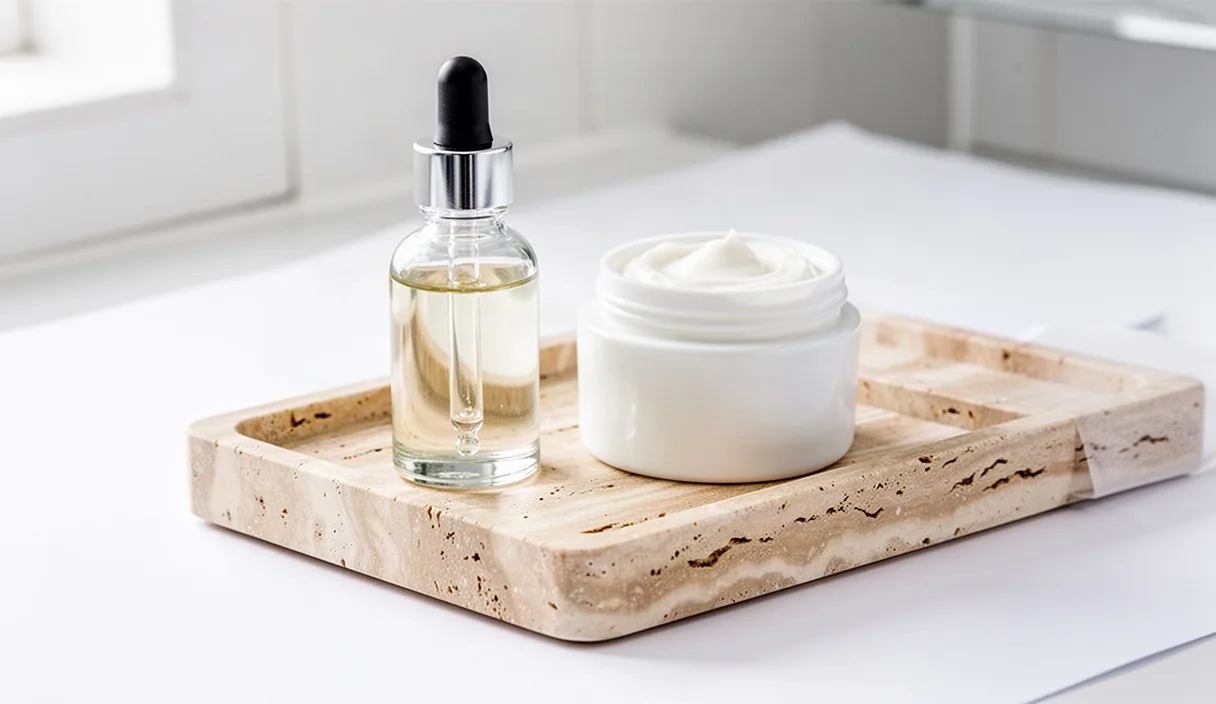
- Press in a barrier cream. Select a moisturizer containing the ceramide, cholesterol, and fatty acid trio. Use roughly a nickel-sized portion, warming it between your palms before smoothing it evenly over your face and neck.
- Finish with a broad-spectrum mineral sunscreen. Ultraviolet radiation triggers matrix metalloproteinases, enzymes that break down dermal collagen and weaken surface repair. A sunscreen built on zinc oxide provides broad physical protection while calming surface irritation.
Evening Routine: Cleansing and Lipid Reconstruction
- Dissolve sunscreen with a gentle oil or balm. Mineral sunscreen and daily grime cling to lipid structures. An oil-based cleanser broken down with polyglyceryl emulsifiers removes these deposits without requiring vigorous scrubbing. Massage it over dry skin for 45 seconds, then rinse with lukewarm water.
- Cleanse with a non-foaming, low-pH wash. Choose a water-based cleanser with a pH between 4.5 and 5.5. The enzymes responsible for synthesizing ceramides inside your skin work optimally in an acidic environment. If a cleanser pushes your skin pH above 6.5, those repair enzymes temporarily shut down.
- Rehydrate immediately. Pat your face lightly with a clean towel, leaving it slightly damp. Apply your panthenol or glycerin serum within 60 seconds to capture surface hydration before it can evaporate.
- Seal with a restorative lipid complex. Coat your skin with a rich moisturizer containing squalane, shea butter, or meadowfoam seed oil along with ceramides. If your skin is actively flaking, apply a thin layer of pure medical-grade petrolatum over irritated patches as a temporary shield.
Signs your barrier has fully recovered its protective function
Epidermal turnover takes approximately 28 days in your early twenties, but stretches to between 35 and 45 days once you pass thirty. For this reason, full repair requires between four and six weeks of consistent, unhurried care. You cannot rush lipid synthesis, though your skin will offer clear physical benchmarks as its cellular matrix rebuilds.
The first noticeable change is the disappearance of transient stinging. When the barrier is cracked, even bland moisturizers or plain tap water can cause a warm, prickling sensation. As the lamellar bilayers knit together, nerve endings in the upper dermis are shielded once again, and applying everyday products feels completely neutral.
Next, surface texture shifts from rough paper to a pliable, uniform finish. Skin that lacks lipids looks crepey and shows fine dehydration crinkles whenever you smile. As water content normalizes, the cells plump up, smoothing these superficial lines. Flaking around the nose and mouth diminishes, and your skin retains a quiet, natural sheen several hours after you moisturize instead of turning matte and tight by midday.
Once you observe steady comfort across a full month, your barrier has likely regained its baseline strength. At this stage, you may consider introducing active treatments like lactic acid or gentle retinoids back into your regimen. Do so slowly, adding a single active product once or twice a week at night. Watch how your skin responds over the following 72 hours before changing anything else. Treat your barrier like an old wool sweater: gentle washing, careful handling, and no extreme heat will keep it in excellent shape for years to come.